• Skip to primary navigation
  • Skip to main content
  • Skip to primary sidebar
  • Skip to footer
Athlete Media Group

Athlete Media Group

find your inspiration

  • Our Story
  • Manifesto
  • Athletes
  • Pioneers
  • Journal
  • Work
  • Contact
  • Join Us

CAPTAIN DONALD LAWSON’S RECORD-BREAKING MISSION FOR DIVERSITY & INCLUSION

1 February 2021 by

There is probably only one thing larger than Captain Donald Lawson’s personality – his targets and aspirations.

Lawson was not raised in what we may call a ‘sailing family’ – he was the first of his generation to do so. He began sailing at a kids camp in Baltimore, Maryland, where his mother worked, and very quickly found his calling. Now, he has set his eye on 12 individual sailing records with the aim of beating every single one.

In the past, sailing has been known as a “white man’s sport”: for example, at present, only a handful of women have competed in the Americas Cup. British sailor Tracy Edwards, MBE recently commented that “Sailing is one of the last bastions of patriarchy.”  In 2017, the Royal Yacht Association revealed that the overall proportion of BAME (Black, Asian and minority ethnic) averaged at 2.6%. No UK clubs reported BAME membership proportions of over 4%.

For the most part, Lawson has been treated with a mix of curiosity and respect. “You’re a nine or ten year old kid, and you’re hopping on these maxis and big cruisers. People look at you like ‘why are you here?’ But at the same time, they’re kind of like ‘let’s see what this kid can do’” he recalls. “And some of it could be hope for failure or hope for success. But the way I looked at it, it was opportunity”.

Though he has grown accustomed to people assuming a lack of talent on the basis of his ethnicity, this has only made Lawson stronger: “It doesn’t bother me anymore because one of my hopes and one of my big goals has been changing their perspective…as previous generations have gone, new generations are a lot more open minded.”

To gain the attention of the sailing community,  Lawson knew he had to be one of the best around, irrespective of skin colour. Whilst harnessing his tenacity and seeking inspiration, he was given stellar advice from sailing legend, Dame Ellen MacArthur.  MacArthur advised Lawson to be actively involved with as many boat types as possible to become an extremely well-rounded athlete “and that turned out to be the best advice [I] ever received”.

Many, including Lawson, believe that America has fallen off the map in comparison to other big sailing nations such as Great Britain and New Zealand, and this was perhaps characterised by team American Magic capsizing at The Prada Cup in January and scoring zero points. Lawson plans to change this. His record attempts will not only be a win for those seeking racial equality, but they will also see the skipper using sustainable energy sources on his boat. Lawson believes he will have a speedier and lighter edge thanks to wind and solar power, resulting in “performance without compromise”.

As an African-American, Lawson has recognised that something – or someone – needs to champion diversity in sailing. So why not him? The sport will “die off and not be sustainable” in the USA altogether if it remains undiversified he believes, because it will not yield great enough interest from all communities. As a consequence, he has taken whitewashing by the horns, and wrestled it to the ground.

“A lot of people in my culture didn’t know that there was an opportunity [to sail]” Lawson explains. If they didn’t know, it was probably because they weren’t invited he goes on to say, “and then if they were invited they were probably shunned out” due to racial prejudices. In combatting such inequality, Lawson has set out on a two-fold approach known as the Race for Equality. Alongside the championing of a 4 Year racial diversity and inclusion campaign, Dark Seas, Lawson aims to inspire those by becoming the first African-American to sail solo non-stop around the world and the first to compete in the Vendee Globe in 2024.

He is also aiming to become the fastest American to sail solo non-stop around the world.  “It’s going to be a while before you see another sailor like myself who competes professionally” due to this lack of diversification says Lawson, however he hopes that he can inspire the next generation through his campaign, and put sailing back on the map for all Americans.

Lawson is already creating quite the fuss on social media platforms, admitting that he gets messages “daily” asking for advice on success and what it takes to get to where he is now “And I always tell people, you know, I’m a human being too, I need support too. And I get my support and inspiration from people who came before me or people who are currently doing it”.

Lewis Hamilton is a major source of inspiration for Lawson, because he is a “very focused and driven person” as well as a go-getter. Lawson has adapted this approach to his career by being scrupulous with his connections: “that’s kind of how I protect myself by looking at it as ‘Who should I work with? Who do I need to be around so I can maximize my abilities?’ And that’s always the hardest part – networking, finding the right people – but I’ve done that now with my partnership with WhiteCap and Simon Clay’s team who will manage both my records and the 2024 Vendee Globe Race.”

Now, Lawson is on a mission of speed, perseverance and diversification. It is by no means a small task, yet it is one he relishes. The captain has set course for not only championing minorities in sport, but the future of American sailing.

You can follow Captain Lawson’s journey into the history books on Facebook & Instagram, or contacting him via email at donald@captaindonaldlawson.com.

“Believing in something bigger than what I am has kept me going” | Imogen Sills

27 January 2021 by

When asked what Imogen thinks her twin, Saskia, and eldest sibling, Sam, may describe her as, what immediately comes to mind is “lucky” and “carefree”. “The stuff that I’m passionate about I don’t go about in the same way as them” she explains, “I never really tell people [about] my goals and passions, I just kind of get on with them and they either work or they don’t…I think that could translate [to my siblings] as being unfocussed”. Despite this unassuming description, Imogen recently placed 9th at the iQFoil World Championships last October, gaining a fully funded position on the British Sailing team.

This has not been Imogen’s first foray in the world of sailing, and it is certainly not her last dance. Imogen’s journey into competitive windsurfing began as a junior athlete alongside her twin Saskia. However, due to a terrible injury Imogen saw herself dropped by British Sailing – an event she thought would break her for good. For some time, she did not want to have any involvement with the sport and she was ready to put her sails away forever.

But as the saying goes, as one door closes another one opens. A short time after she received the upsetting news, Sam asked her if she would be interested in going to Norway to coach the junior windsurfing team as he could not fill the position. After some deliberation Imogen headed out to Norway for a trial period of coaching, falling in love with the sport from an angle she had not experienced much of: “I used to say getting taken off the team was the worst day of my life, but actually was the best day of my life. Now I look back and I just think, wow, if that didn’t happen, where on earth would I be now?”

The opportunity wasn’t exactly handed to Imogen on a silver platter though. Upon arrival it was evident that the team operated in a way that Imogen was unused to. The windsurfers sometimes clashed due to the belief that they had to compete against one another, causing uncooperative behaviour amongst them. In response to this, Imogen set course for an atmosphere of collaboration. Eventually she was able to instil the idea that teamwork was essential and “if you don’t work together, we’re not going to go anywhere”.

The fruits of her labour paid off at the 2018 European Windsurf Championships in Greece with every athlete exceeding their expected result –  “they sailed another level than they’d ever sailed before” Imogen recalls. Imogen was overjoyed that she could be part of the experience: “I think that regatta is one I’ll never forget because it just showed that if you believe in yourself, and if you believe in your way and [let] people believe in you and you work hard, anything is possible.” She credits the Norwegian team for throwing her a lifeline and taking a chance on her, providing her with one of the most exhilarating opportunities of her life.

As a woman, Imogen’s perspective of gender in the sport has gained new insight from her coaching role. The most prominent factor was the number of female coaches in the sport overall. Though the athlete gender divide is narrowing in windsurfing, the male to female ratio in windsurfing coaching remains vast, with Imogen approximating the ratio to be roughly 8% women on the international scene. Research by Dr Leanne J Norman of Leeds Beckett University show that the percentage of female accredited coaches across all Olympic sports stood at just 11% at Rio 2016, with 89 out of 197 of competing countries having no female coaches whatsoever.

Imogen is thankful that her boss is highly supportive of engaging women in sports management roles, however she believes that women have to jump through many more hoops as coaches in comparison to men, purely due to gender bias.

She also saw another side to the sport as the Norwegians had only began to offer a separate, dedicated race for women in September 2020. Prior to this, the cups which they raced for were open events and rarely allowed women to achieve any recognition. Imogen is nonetheless positive that change is happening outside of the UK – “the recognition of your efforts – no matter what gender you are – is really important”.

Imogen has now found herself in a position which she did not expect. Whilst working as a coach she was asked to try foiling at a British Sailing talent identification programme. Though she had not been on the board as a competitor for some time, it turns out old habits die hard. After grinding away through 2020 Imogen was once again a fully funded windsurfer, laying down an epic performance at the World Championships in Lake Garda, Italy. Now she has set her sights on Paris 2024, and is taking the advice of her older brother which he gave to her and Saskia: “work hard, girls, you won’t regret it.”

“Without sport I would feel incomplete” | Sedem Ama

21 January 2021 by

It is evident that women’s boxing is booming. Women’s boxing has existed as a sporting pursuit for a long time, however official competitions are a recent addition to the sports events calendar. According to sport sociologist, Professor Kath Woodward, the first European cup for women was approved in 1999, followed by a women’s boxing World Championship in 2001. Sometimes it is viewed as “controversial” Woodward writes – yet, irrespective of this, boxing is extremely positive for women. It allows participants to keep fit, learn discipline, and “gain self-esteem”.

Keeping active, disciplined and maintaining a good level of self-esteem are all useful tools if we are to try and bear the impact of a third lockdown in the UK. Experts have been vocal about the potential mental health crisis for generations to come post pandemic. Figures published by The Telegraph revealed that ‘the number of children referred to child and adolescent mental health services (CAMHS) was 4,615 per 100,000, the highest on record and up nearly 20 per cent on last year’. In 2020, the Office for National Statistics reported that during the pandemic, depression in adults had almost doubled from what it was pre-pandemic.

Athletes are by no means unaffected either, yet it is arguable that we have something to learn from them. The Sports Injury Bulletin recently wrote that routine and exercise are key to better mental wellbeing, particularly in a period where we may face isolation. Amateur boxer, Sedem Ama, also recognises the importance of these tools in a period of uncertainty: “Completing a task, whether it be going for a daily walk means you have accomplished something, so it’s really important to find discipline to help during times like these.”

For Ama the benefits of boxing on not only her physical health but her mental health are unparalleled. Alongside her amateur boxing career Ama balances a full-time career in PR. It certainly makes her schedule somewhat pressured. A typical day for the boxer requires an early morning wake up followed by cardio or strength and conditioning, a full 9-5 day of work, and then a 2-hour session of technique and bag work at the club. “I have found that without training, my mood can falter and that’s simply because of the exhilarating emotions I get, even during a really challenging session” Ama writes. “Boxing gives me a sense of accomplishment. When I train in the morning, it gives me a fulfilment to conquer the day, and my evening sessions also allow me to then close the day and sleep well which is so important for recovery. Personally, without sport I would feel incomplete”.

It is evident that Ama is not alone in the search for endorphins either. The interest in women’s boxing has grown exponentially in the last 4 years. Data produced by Sport England shows that between 2018 and 2019, 420,400 females were involved with boxing and boxing related activities (such as boxercise). This has risen from 386,000 in 2017-2018, and 356,500 the year prior to that. “I love the fact that I’ve come in at a time when it is booming and people are paying more attention to [the] females in the sport” Ama explains. She acknowledges that boxing remains a male-dominated sport, but points out the salient fact: “females have talent too”. The ring is no longer a ‘men only’ zone says Ama, “we’re not just in there to look pretty…we can fight. If we want to box, we can box. If we want to brawl, we can brawl.”

Perhaps what is key to Ama’s success thus far is her decisions to surround herself in a supportive, yet stimulating, environment. Not only does she have strong support from her family (though she does joke that they would prefer it if she “was playing golf” instead of watching her get punched), Ama emphasises the importance of her friendships too. “I only have friends who are as ambitious as I am” she highlights “and that’s not by accident”. For Ama it is crucial that to be passionate about one’s purpose those around her should be similar minded: “We all push each other to be the best in whatever area we’re in.”

Passion and purpose in Ama’s personal network translates directly to her sports ethic. Originally she started at Double Jab Boxing Club, however her hunger for progress lead her to Repton Boxing Club which prides itself on being one of the oldest established boxing gyms in the country, and one of the most successful. The club’s motto is ‘Non Viscara…Non Gloria’, which translates to ‘No guts…no glory’ and indicates how seriously they take their training, whatever level the athlete may be. Immersing herself in a competitive atmosphere is what brings out the best in Ama, pushing her harder and polishing her into an exceptional athlete. 2021 has begun unfavourably for many, however keeping active, being disciplined and staying connected in a supportive environment like Ama are key to moving forward.

FOR SON AND COUNTRY | Marlie Packer

19 January 2021 by

Named as one of the top ten female rugby players in the world by The Telegraph for ‘her industriousness at the breakdown’ earlier this month, one can only wonder how much more Marlie can give the world of rugby. The answer is: one hell of a lot.

Currently, Packer has made 74 appearances for England, and plans to make it more. However, her attitude to the game has changed over the years she explains. As she has had a few injuries over the past few seasons, she is looking to “Play every game as [her] last”, focussing on completing one game at a time. “Every game that I play in I want to be one of the standout players and be the best player on that pitch” says Packer, and this has reduced her number of long-term ambitions and bettered her outlook: her rugby style has shifted to one of quality over quantity.

2021 is set to be a huge year for women’s rugby, with many hoping that the 6 Nations tournament will still go ahead in early spring, plus the Rugby World Cup 2021 which is set to be held in Autumn in Auckland, New Zealand.  Statistics in 2019 showed that women’s rugby has had an unprecedented increase in interest, with participation levels reaching an all-time high with 2.7 million players globally.  England Rugby also stated that more than 40 per cent of rugby’s 400 million fanbase are female. Packer is hopeful that the year will take off.

When Packer started rugby at an international level she did not think that she would ever get paid as a professional rugby player. Much to her surprise, she was offered a Rugby 7s contract soon after making the statement in a televised interview in 2013, which lasted for 4 years until 2017. It was only in January 2018 that the England Women’s rugby team, also known as the Red Roses, were offered full time contracts, making them the first women’s rugby team in the world to go fully professional, reported rugbyspeakersuk.com. The game has gone “from strength to strength” Packer beams. As the game becomes more regularly televised the better the coverage of women’s rugby will be Packer believes, and the team will be even more motivated to show how exciting the women’s game is: “If we keep getting better and challenging each other…we will put on a performance that people will want to pay and come watch and really enjoy.”

Of course it is not just the fans which Packer is looking to perform for now, but her partner and their new-born son, Oliver. Life has changed drastically for Packer since becoming a mother, however it has only added to her drive to play the best rugby she can. Upon being asked whether her focus on rugby had lessened since her entry into parenthood, she was quick to highlight that Oliver and rugby are joint in priority. Though they are “two different sides” of her life they greatly complement each other: “everything I do from now is not about making myself and my family proud, but making sure that my son can look back and say, ‘that was my mummy at the World Cup’”.  To inspire the next generation, as well as her son, is a major goal for Packer.

It is by no means easy to balance the two however, evidenced by Packer’s deflation that she will be at the Rugby World Cup during Oliver’s first birthday. She likens parenthood to the game in that you can “read all the books in the world” on what to expect – you can analyse the tactics, replay the scrums – but you will not truly understand what to do until faced with the situation. “You have to adapt very quickly and deal with what’s actually in front of you” Packer advises sagely.  Though this is her first child, it is clear that the sport her has taught her valuable lessons beyond the pitch. She credits her partner, Tash, as well as friends and family for helping them adapt to family life.

With 4 Grand Slams, 1 World Cup win, and back-to-back Tyrrells Premier 15s titles it is possible that Packer is one of England’s most successful players, yet this is not slowing her down. “I’d like to become a back-to-back Grand Slam champion” says Packer, as well as beating the All Blacks on their home turf this autumn. The overall goal is to remain the number one women’s rugby team in the world, as well as a number one mum to Oliver.

BIG AIR AND BODY POSITIVITY | Lily May Young

15 January 2021 by

Unknown to Lily May Young, her life was about to take a dramatic new direction after she entered an athlete recruitment initiative with British Kitesports. Looking for talent ahead of the 2024 Olympics, the National Governing Body sought out the highest-performing junior women in a drive for more female talent. 160 applications were originally made, and after several rounds athletes were cut down to a group of 5 that would constitute the official GB Kitesurfing team. One of the 5 was Young.

Originally, Young sailed and windsurfed to a high level, competing at the 2015 Youth World Championships in Poland. A self-proclaimed water-baby, the transition for Young came naturally despite a very physically demanding programme which required her to learn how to kite in a short period of time. Now she spends most of her time training with the goal of Olympic qualification, hitting speeds of up to 35 knots (40mph) .

“It didn’t matter that I changed sports” Lily explained. “For me, it was just competing and being on the water. Being outside is just something that I absolutely love.” Though her swift transition appears close to miraculous to the untrained eye, Young freely discusses how there are many challenges which she faces in the sport: “With reaching those top speeds come pretty big crashes which can hurt quite a lot [and] can make your days quite mentally challenging… You’ve got to push through that. But it’s days like those that make us do better.”

What is particularly exciting about kiting’s Olympic debut in 3 years-time is that it is going to be a mixed relay, with one male and one female representing each qualified nation as a singular team. In pursuit of a greater gender balance in the sports, the Olympics 2020 programme will offer 9 new mixed events in archery, judo, shooting, swimming, table tennis, the 4x400m relay, and triathlon. Though the exact course and format for kiting is yet to be formally confirmed, Young states that it is likely that the mixed gender relay will be the only kiting event, making it unique in comparison to the other sports the Olympics offers. This also means that the selection will be even tougher, with one spot for a female kiter and one spot for a male.

Young is highly supportive of kiting’s attitude to gender equality, describing the atmosphere as “relaxed” and “cohesive”. “There’s less of a divide between the males and the females” she explains, “We all race together quite often, which doesn’t really happen in sailing. Males and females will sail slightly smaller [kites and] we can – if we want to – use those exactly the same kites as the men” – ultimately, it is down to one’s preference of kite.

Following on from this, kiting is making leaps and bounds in term of securing fair play during the Olympics. In May, SurferToday reported that ‘kite manufacturers must provide detailed information (material, dimensions, weight, etc.) on the developing process to ensure that all athletes have access to the same equipment.’ The reason for this regulation is that the Olympics is trying to prevent an ‘arms race’ with custom-made kit, eliminating ‘technology doping’ and ensuring that the winner’s merit is based on their skill, not their fancy foils.

Introducing a mixed gender event also leads to more respect for one’s competitors Young tells AMG. Young and her teammates often race against and with each other irrespective of whether they are male or female. Due to their competitive nature, the team will fight tooth and nail to out-surf one another, however sex and gender are irrelevant factors. Though they may compete in binary categories, they are at the end of the day a single team. Young sums it up succinctly: “you’re still on the same course as them”.

In pursuit of gender equality in kiting and beyond, Young believes that part of the larger picture is redefining beauty standards in sport. From her perspective, championing women as strong and competitive athletes is the way forward. There is some inevitability that we want to look good Young explains, but how we view what ‘looking good’ is in sport is not a one-look-fits-all approach. Rather, we should appreciate athletic bodies and feel good about what they can achieve: “I have really strong shoulders and legs from weight training but I am happy with the way I look”. Many people are mortified by the thought of wearing a wetsuit and being in the cold, however it does not phase Young. In sport she finds it “super encouraging” that athletes can simultaneously look strong “and have a great time”, and she hopes that this is something she can promote as an elite athlete.

“It’s attention & time that are in constant conflict but I love it.” | Jade Lally

12 January 2021 by

Following on from our interview with GB Olympian Zoe Gillings-Brier, athlete Jade Lally has weighed in on her experience of motherhood. Lally’s original involvement in sport began with high jumping in school, however she was quick to discover her natural talent for shotput and discus.

As discus is a less popular sport in the grand scheme of athletics, Lally must strike a balance between her new venture into parenthood with her involvement in a lesser-funded sport.

There are many misconceptions surrounding discus throwers (“that you need to be massive” or “fat” Lally points out) but also misunderstandings that female athletes will stop their involvement in elite sport due to motherhood: “I think there are people that will judge my decisions on still being selfish and still trying to make a career alongside being a parent. But I don’t pay attention to them. I know I am a good mum and do my absolute best to be there for her and give her the best life I can.”

Photo by Getty Images

Lally’s pregnancy came as a blessing in disguise. Talking to AMG, she revealed how she hadn’t always wanted to be a parent. Though she had thought about the possibility of parenthood, she assumed that if she were to do so it would be at a point in her life where she could carry a child on her terms. Although the pregnancy came as a surprise, Lally remains immensely grateful for the timing allowing her to carry a healthy baby to 37 weeks, despite her waters breaking at 25 weeks.

For Lally the new venture as a mother has not always been plain sailing. Compatibility of an elite sports career and parenting was always a concern. “For some people it would be [compatible], for others it’s career over. I hoped I wouldn’t be the latter” she explains. “I’m not rich and I rely on my own abilities to manage money to make my life work…Aside from money, it’s attention and time that are in constant conflict. I want to be the best athlete I can possibly be, which takes time and effort. I also want to be the best parent I can be. Which also means time and effort, but also to be present.”

Nonetheless, it would appear that the very nature of sport allows women to prepare for motherhood in a unique way. Although parenthood is regularly cited as extremely challenging at times, it is also often very rewarding – very much like sport. “Prioritising things, making sacrifices and difficult decisions” are all parts of sport she is accustomed to explains Lally, “parenting is a bit like that. It is also about accepting that plan A probably won’t happen, so adapting plans and getting things done no matter what is definitely something that happens in sport that crosses over into parenthood.”

Photo by Adrian Howes Photography

It is certainly possible that sport could do more to help athlete mothers however, particularly in the less mainstream sports such as discus. Though there are heavily publicised, regularly televised athletes who are also mothers, the financial aid and maternity support for women in smaller sports does not compare. “Not even the Governing body offered a congratulations” Lally notes, but “There are plenty of athletes that are just as good as [mainstream sportswomen] that haven’t received that help.” Her grittiness has undoubtedly increased since giving birth to Nyla. Due to the “carnage” which her body undertook she had to take time to recover, retrain and get back onto the international scene: “the ‘lesser known’ athletes that have made it back to international level after having a baby are tough women and not to be underestimated.”

Though Lally’s focus is now bifurcated into caring for her daughter and competing at a high level she is adamant that both parenting and sport remain her priorities and enjoys watching Nyla continue to grow and develop. In terms of her future plans, Lally has rightly set a high bar: “[I want to] Go to my second Olympic Games. To win the Birmingham Commonwealth Games in 2022. To go to my second World Championships.” AMG will be supporting her the whole way.

Photo by Getty Images

GUNNING FOR GOLD | Georgina Roberts

8 January 2021 by

At the time of the interview in early December, Roberts was in-between homes: for her coaching role she is on the road and staying at hotels. Because of COVID-19, Roberts had not been home to Flintshire for a while as lockdown restrictions encouraged minimal travel between England and Wales.

The daughter of a farmer, Roberts had always been aware of sports shooting. However, her first involvement with the sport was at a local charity event on a give-it-a-go stand. After impressing (the now former) Great Britain shooting team member, Katie Cowell, Roberts was quickly taken under the wing of one of the coaches. Within the space of six months Roberts achieved her first Welsh cap, quickly transitioning and making an appearance for Great Britain at the Junior World Cup. “It was a bit of an emotional roller coaster” Roberts explains. Despite this she was very well supported and “very fortunate” that her school encouraged her to push her athletic limits: “it was a real life-changing year, going from no shooting at all to going through those different transitions. It was good!”

Limit-pushing remains at the top of Robert’s agenda, especially with 2021 holding much more promise than a turbulent 2020. If balancing a part-time business degree, a job in digital publishing and an elite career in shotgun shooting wasn’t already enough, Roberts is determined to add to her silver (or gold) ware. Upon being asked whether she prefers being an athlete to a coach she is quick to add that being an athlete is her current priority: “I want to win that medal, I want to go to the Olympics, I want to be an Olympic gold medallist – which you can’t do as a coach. You can coach an Olympic gold medallist, but I want to have that medal for myself [first]”.

Nonetheless, Roberts is certain that she wants to help people do the same in the future, too. At the age of 23, Roberts prides herself on being not only a successful athlete with plenty of ambition, but also a fully qualified shotgun coach with both ISSF D Coach and CPSA Safety Officer licences. Though competing as an athlete was her first love, coaching is definitely on the cards once she has completed her competitive career. “I love helping people and trying to help other people achieve goals using various different techniques” says Roberts, “and I don’t think I’ll ever be able to stop coaching [because] it’s something I feel so passionately about.”

Off the shooting range, Roberts’ commitment to the sport has seen national recognition. In 2019, she was the recipient of a Women of the Future Awards for her dedication to sport, beating multiple other recognised and decorated contenders. Talking to the British Association for Shooting and Conservation (BASC), Roberts spoke about how she didn’t expect to be even shortlisted, never mind winning, and the recognition of her hard work meant “the world” to her.

In such a short span of time Roberts has exceeded many people’s expectations, yet she still plans on pushing herself and harnessing her passion for the sport – this includes the championing of shooting as a sport for both men and women. Roberts highlights that she has been fortunate that few of her experiences in the sport have been negative, mainly emerging from a lack of understanding rather than ill-intention. Today the sport remains ‘very male dominated’ according to BASC, but there has been a great increase in female interest with shotgun certificates issued to women in England and Wales reaching over 1000 in number as of June 2019. The Telegraph also reported last year that ‘The number of firearms has risen from just over 435,000 in 2008/09 to more than 596,000 in 2018/19 with the number owned by women having increased by 10 per cent in just two years, from 32,400 to 35,600.’

Roberts has met many amazing women through the sport, however every one of her coaches have been men – all of which have helped her on her journey as both athlete and coach. Upon asking her what advice she would give to aspiring sportswomen, Roberts states every athlete should know why they do the sport. Knowing what the ‘why’ factor is, Roberts suggests, is the foundation of athletic enlightenment. Robert’s ‘why’ factor is threefold: “to protect and promote my sport…to encourage and inspire others” and “to strive for greatness”.


“It’s the little conversations that add up” | Kirstie Urwin

4 January 2021 by

One thing that Urwin was acutely aware of during her junior career was that she could only ever compete in single gender categories, with the 420, 470 and 49erFX classes being separated into male and female. However, when Urwin progressed into the Nacra 17 class – the fastest and most technologically advanced boat class – she was then able to pair up with male athlete, Rupert White.


Both Urwin and White were selected to go to the 2012 ISAF Youth World Championships in Dublin, with Urwin bringing back a bronze and White a gold. White had also recently won another world title and Urwin the European title. During this period of amazing success the two became great friends, however they continued to compete separately until 2015.

During the interview, Urwin explained how she found the Nacra 17 class as deeply empowering for it has the ability to break down gender stereotypes that sport is so often tainted by. When the class was introduced “the immediate assumption was that all of the crews would be male and all of the helms would be female because of the physical aspect of the crews role”. However Team White-Urwin, along with multiple other teams, went against the grain and placed White at the helm, and Urwin as the crew: “so many of us have just completely smashed that misconception out of the water and proved time and time again that there’s absolutely no reason why we can’t compete against those male athletes and do just as good a job as them, if not a better job.”

Breaking this barrier down further, the Rio 2016 Olympics saw Nacra 17 gold, silver and bronze medals being awarded to Argentina, Australia and Austria respectively. All three of these teams had a male helm and a female crew. Urwin commented that this was quite unexpected, but nonetheless a humongous victory for female athletes: “the medallists that Rio 2016 [saw], were all the opposite way around in terms of physicality…and that’s a really empowering thing. I think when it comes to women in sport, it’s all about sport being open-minded and giving people the opportunities.”

Challenging the status quo is a major part of Urwin’s philosophy, and certainly a principle that she carries throughout her training and competing. Being a woman in sport is doing just this she suggests, but we need to be more aware of how we treat female athletes in comparison to men and the expectations that we hold these athletes to in a gendered light: “I think every time you challenge a female athlete on what they can achieve…you beat down what their own internal perspective of what they can achieve is, and we need to be building those athletes up. We need to be saying to female athletes there’s no reason why you can’t achieve what male athletes are achieving…And as you challenge yourself, you can break those expectations and prove them wrong.”

Urwin is keen to state how elite sport is not only physically challenging but mentally challenging for those who participate, too: “there’s challenges to being in an elite sports person because of the level that you’re pushing your performance to, and you’ll strive [for] perfection in everything you do. Obviously there’s going to be challenges in terms of your mental health but I think it’s all about the balance, realising that you’re competing in a sport, you’re getting to travel around the world and trying to really draw on the positives of the mental side”.

Having undertaken a mental health first aid course and completing a degree in Sport Psychology Urwin has found herself aware that not only does being active bring a release, but sailing also allows her to “learn about different cultures, different perspectives” and meet people that show you “what you can achieve and what can be done when you put your mind to it”. All too often athletes are portrayed as indestructible superheroes which can lead to mental health being put on the back-burner in many elite sport communities. Only recently has discussing mental health in elite sport really moved into the spotlight, for example the BBC documentary on Andrew Flintoff and his battle with an eating disorder, and West Ham United captain Gilly Flaherty discussing her mental health struggles.

In 2019, The Independent reported that athletes have helped provide a huge shift in attitudes to discussing mental health. Deputy CEO of charity Sporting Chance, Shellie Heather, stated that “The more players/ex-players that speak openly about their issues in the press and media often leads to a spike in calls”.

Communication and de-stigmatisation are key to moving forward Urwin highlights, and something which athletes, coaches, and the teams can do more of. Sports ultimately should not be an area which shies away from discussing mental health, but one that promotes it’s importance: “if we can be vulnerable…[and] really show that despite those issues that we have and those challenges that we have, we’re able to rise above that and perform to such to an elite level, then there’s no reason why anyone else can’t break through those barriers as well.”

Yacht designer, sustainability champion, world class windsurfer | Sam Sills

21 December 2020 by

A recent report produced by Brunel University suggests that even a Christmas dinner can produce a carbon emission larger than a single flight from London to New York. With society frequently incorporating methods of being ‘more green’ and reducing its carbon footprint, people are continually looking for new and improved ways of being eco-friendly.

Because of this social change,  sustainability is often a passionate cause for many athletes, with AMG supporting Hannah Mills, Saskia Sills and the Big Plastic Pledge. Though he may not be cooking his turkey ‘sous vide’ this year as the scientists advise, champion windsurfer, Sam Sills, has contributed his efforts and championed the reduction of sport’s carbon footprint in an alternative way.

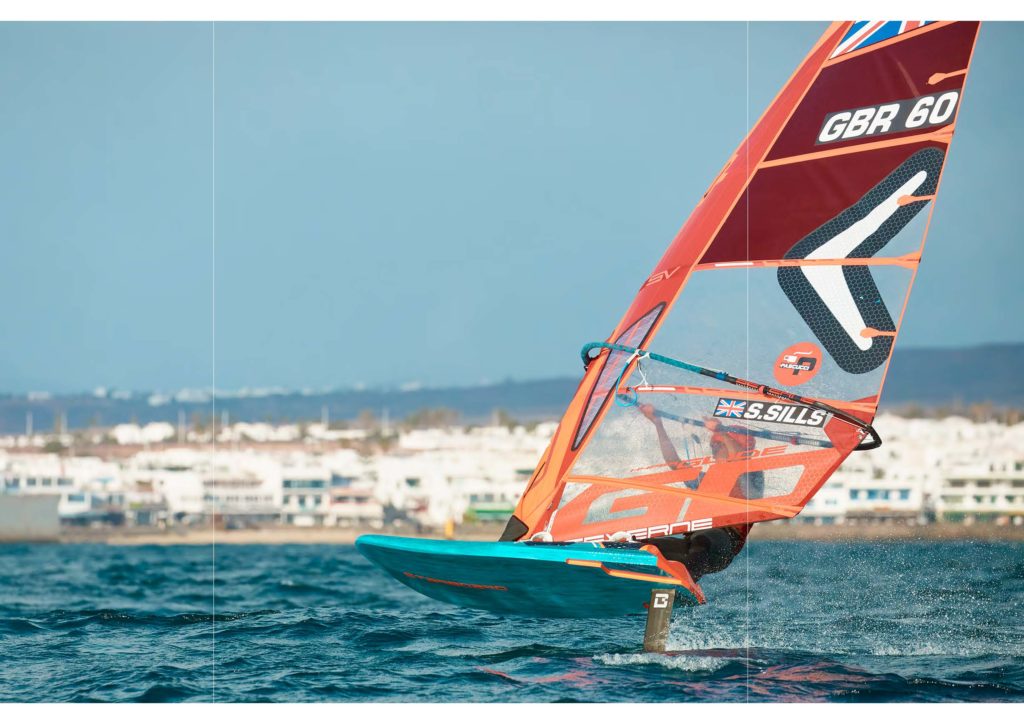
Photo 1: Sam speeding along on his IQ Foil  (Credit: Felix Diemer) 

It is evident that Sam is heavily influenced by his home county, Cornwall. With white sands, crystal clear seas and plenty of lakes, Sam was quickly hooked on the windsurfing scene available to him, yet equally passionate about maintaining the beauty of the place he fondly calls home.

Having travelled far and wide with the sport – from far flung and exotic locations such as China, to European destinations such as Madeira and Scandinavia – Sam has at times lived in his van for maximum efficiency, decked out with solar panels, facilities to cook and a place to sleep. He does however confess that it was particularly tiring to windsurf at a high level and achieve sufficient rest whilst living on wheels, therefore he is impartial to an Airbnb stay when necessary.

Perhaps Sam’s most exciting contribution to reducing windsurfing’s carbon footprint is through his career as a naval architect which he undertakes alongside competitive windsurfing. Having graduated from Southampton Solent with a 1st class degree in Yacht and Powercraft Design, Sam has put significant efforts into making sailing and board sports greener. In 2014 he was a finalist in the Royal Institution of Naval Architects (RINA) Innovation Design awards with his final year project where he designed a luxury 24m Trimaran in a wood and carbon fibre composite, aimed at investigating sustainable Yacht design alternatives and reducing environmental impact.

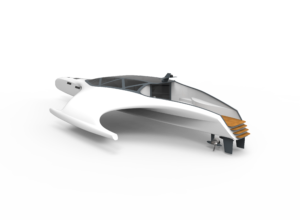
Photo 2: one of Sam’s designs

Recently, he has been working on electric boats in Norway with ZEM energy. The boats are without engines, emissions-free, and are almost entirely powered by renewable resources. He has also been working with Kona Sports in Sweden, where they have managed to 3D-print prototypes using a special by-product tree resin, recycled from the wood industry. As a result, prototype boards used in creating the final design, were completely recyclable and created zero waste.

Sam also attributes a lot of his inspiration from sister Saskia. As she is a Geography graduate and works with The Big Plastic Pledge, she understands “how we should face” environmental issues at a deeper level –  “that really has been amazing for me to kind of soundboard off her and hear what she thinks in terms of how it can improve things, so that’s been amazing!”

Photo 3: Sam’s sister & sustainability inspiration, Saskia

Not only is Sam championing better methods of sustainability in sport, but so is the wider windsurfer community. Recently, the iQFoil by Starboard became the official Olympic windsurfing equipment and has multiple environmental pledges, including a plastic offset programme and a ‘carbon net positive’ programme, where Starboard plant a mangrove tree for each board produced.

For Sam it is not only about raising awareness surrounding sustainability in sport, but getting people to “kind of fall in love with [nature] and then take more care of it”. Sam, along with his sisters Saskia and Imogen, are Olympic hopefuls for Paris 2024. Currently, he is training in Lanzarote, the Canary Islands, until the racing season begins in March. 2020 is almost over, but Sam Sills Olympic hopes are only just beginning.

“LIFE ISN’T ABOUT FINDING YOURSELF, IT’S ABOUT CREATING YOURSELF”| ELLEN MEEKINS

15 December 2020 by

The future looks bright for OCR as it is a contender for the Olympic Games: The Mission of FISO is to promote the Obstacle Sports throughout the world, to lead Obstacle Sports, and meet the requirements as specified by the International Olympic Committee and the International Paralympic Committee.

British athlete Ellen Meekins’ first foray into Obstacle Couse Racing (OCR) began when she and her brother, Oliver, entered a Tough Mudder competition for fun in 2018. In preparation for the Tough Mudder, the Meekins siblings decided that they would also enter a Spartan Race not knowing that Tough Mudders are considered as a teamwork-based ‘fun run’ and Spartan races are tougher, ‘fun run’ and Spartan races are tougher, more physically challenging and has the  slogan: “You’ll know at the finish line.” After weeks of training, Ellen won her age category and finished in the top 4 of the competitive female race: “I thought ‘okay – well, this is something I could be quite good at’ and I just decided I loved it so much [I] became obsessed”.

Since this adventure, Meekins has established herself as a competitor on the OCR World Championships circuit. Though the buzz of winning is a great enough endorphin-high to keep her elated for weeks after the competition, it’s not actually the winning which keeps her motivated. Part of her love for OCR is the people. “The enthusiasm, the love, it’s amazing” she comments, “I did a race in Madrid last year and it was between me and this other girl. At the finish line [it was] just big hugs, [we started] following each other on Instagram, and started messaging each other”.

Meekins also highlights that it is not just the people but the places she gets to go. Whilst talking to AMG, she lists the multiple places around the world which she has been able to venture via the means of OCR. From smaller courses at Twickenham Stadium to racing up Big Bear Mountain, California, the difference of the trails and terrains are what keep Meekins excited to swing through monkey bars and master sternum-checker logs.

“I love actually the training” Meekins exclaims when AMG asks her why she loves OCR so much. “You never actually feel like you’re training. On my training fitness program…it’s so varied. I just enjoy the actual journey to get to the race.” Perhaps a testament to Meekins’ claim is how she encouraged her mum to train and compete alongside her: “At the moment she can do a couple of monkey bars, but our goal is that she’s going to run her first race in Majorca next year and I’m actually going to run it for fun with her…It’s a sort of training for every day – picking up heavier things and picking them up correctly and being able to run. It’s quite amazing.”

Though Ellen is currently ranked as one of the top female obstacle course runners in the UK, it is clear that OCR is not just an event for the seriously competitive but for family and fun-runners alike. It is possible that OCR holds an important key to increased fitness cross-generationally. A 2018-19 survey by Sport England showed that as the population ages, inactivity levels increase massively. However, participant age range in Tough Mudder competitions varies from 24 to 49 years of age, plus the UK Obstacle Sport Federation offers race age categories from under 9 years old to 40+. As of 2020 there are 31 national obstacle course federations in Europe and the number is continuing to grow, however 50 federations are required for Olympic consideration.

It would appear that, although the training has specific elements, OCR is a combination of different skills and would be a great fitness opportunity for anyone who enjoys exercise. Trail running, CrossFit workouts, free weights and mobility exercises all come in handy Meekins mentions, however there is such a variety within OCR that many disciplines are catered for. Racing takes place over distances starting at 100m (sprint) to 50km (60 obstacle Spartan race). There is also the opportunity to do it as part of a team relay or just for fun – “There’s definitely something for everyone”.

Meekins journey into OCR has not only provided her with the opportunity to get fitter, faster and stronger, but has also offered her more unique experiences along the way such as competing on the television show Ninja Warrior (UK). It was an “amazing opportunity” where she “learned a lot”, however performing in front of a crowd certainly made the challenge harder. Nonetheless, it has allowed Meekins to further focus on high pressure situations.

A motto Meekins’ holds onto is that ‘Life isn’t about finding yourself, it’s about creating yourself’, and it is something which many people could truly benefit from. Meekins explains that the motto means that she believes in new challenges, “testing yourself, seeing what you can achieve builds who we are. This sport is a way I have built myself up by doing things I did not know I was capable of. New experiences, seeing new places and new people, I believe will build a better you.” It is a motto that many may benefit from, and OCR could be the sport to push the boundaries whatever the age and whatever the gender.

  • « Go to Previous Page
  • Page 1
  • Interim pages omitted …
  • Page 15
  • Page 16
  • Page 17
  • Page 18
  • Page 19
  • Interim pages omitted …
  • Page 27
  • Go to Next Page »

Primary Sidebar

Recent Comments

    Archives

    Categories

    • No categories

    Meta

    • Register
    • Log in
    • Entries feed
    • Comments feed
    • WordPress.org

    Subscribe to AMG Newsletter here

    Footer

    © 2026 Athlete Media Group Ltd All Rights Reserved

    MENU

    • Our Story
    • Manifesto
    • Athletes
    • Pioneers
    • Journal
    • Work
    • Contact

    USEFUL

    • Advisory Board
    • Privacy Policy

    CONTACT

    mark@athletemedia.co.uk

    tel: 07952 304340

    VAT REGISTERED ADDRESS

    Thatch Barn
    Ryewell Lane
    Hoath Corner
    Edenbridge
    KENT TN8 7BS

    We use cookies to ensure that we give you the best experience on our website. If you continue to use this site we will assume that you are happy with it.